Background
Content Area: 9th Grade Language Arts
Title: Building and Performing a Shakespearean Sonnet
Pre Planning
Big Ideas
- Rhythm is crucial for poetry and also can change the meaning of language
- Shakespeare’s sonnets are a crucial part to the evolution of poetry and music.
Essential Questions
- How does the rhythm and meter of how I say something affect its meaning?
- How did Shakespeare’s sonnets play a role in how modern music has developed to what it is today?
Objectives: Students will be able to
- Identify a define iambic pentameter, rhyme schemes, and stanzas
- Connect classic instances of poetry with modern, contemporary music
- Create a Shakespearean sonnet with accurate rhyme scheme and meter
Summative Assessment: Shakespearean sonnet
Materials
The apps used in this lesson are pre-loaded onto the iPads in the 1:1 cart located in the room, but can also be accessed via the students’ personal devices. The apps needed for this lesson are listed below
Lesson
Initiating Activity
Students will begin class with a free-writing activity for the first five minutes. They will use the Prompts app to help kick start their writing and then continue writing using the app. This activity will help them to get the “creative juices flowing.”
Body
Students will use the YouTube app to watch the CrashCourse video on Shakespeare’s Sonnets (12:26).
Check for Understanding
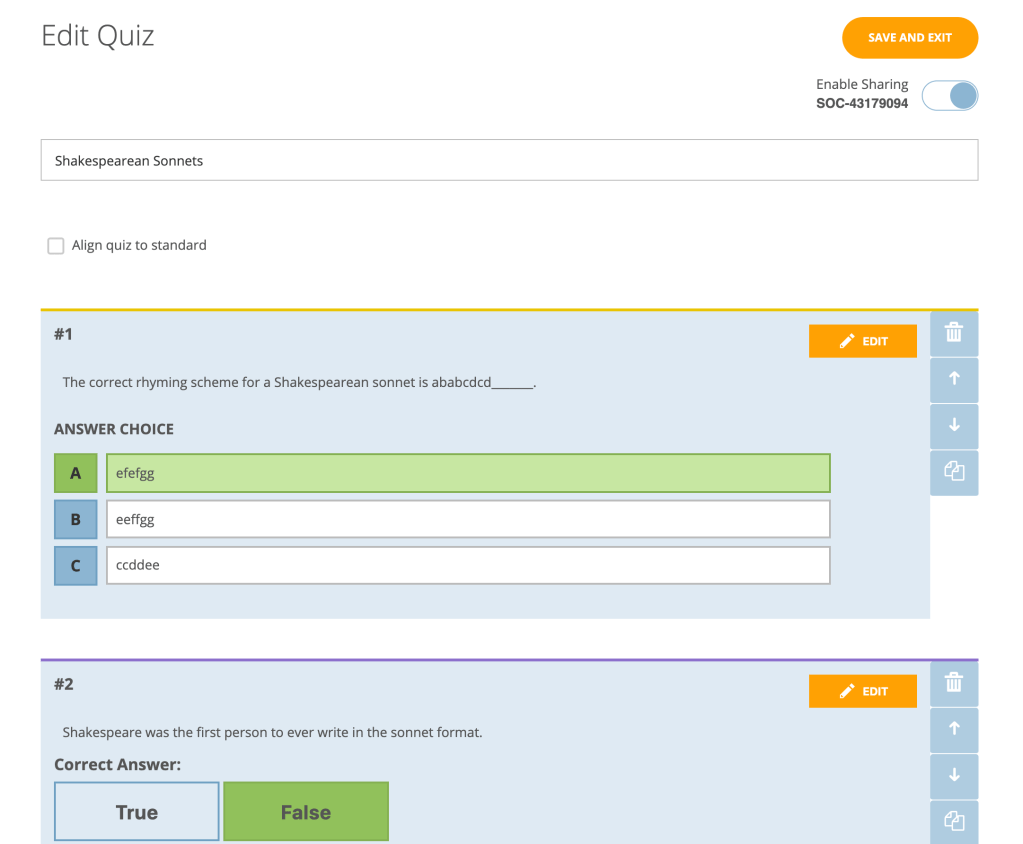
After finishing the video, students will take a quick 5 question quiz using Socrative (quiz would be live only during lesson and strictly on app. Therefore it cannot be linked. A screenshot of the quiz is below.
Extended Practice
Students will create a sonnet using Lyric Notepad, which tracks syllables and helps with rhyming words to help students with rhyme and meter. Students can also use the Shakespeare Pro to read more of Shakespeare’s sonnets for examples and inspiration.
Lesson Closing
Part of writing poetry is performing it to hear the rhythm and fine tune it. Using Flipgrid, students will record themselves reading their sonnet. They will then listen to others’ poems and leave video constructive feedback. They will also contribute to the other discussions, based around the essential questions:
 Jared Pyles